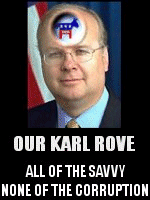
"Our Karl Rove is the blog you should be glad that Democratic strategists don't seem to listen to"
-- what they're saying on Republican blogs

Monday, December 19, 2005

Democrats: Take Responsibility for Bush Improvements

Democrats,

Bush recently gave a speech about the war in Iraq that was well-toned, contrite and more honest than ever before. In fact, Harry Reid said "The president has reached out and spoken more directly than ever before about how we went to war and why it is important to achieve victory, a goal we all share."

Unfortunately, you missed a key Rovian strategy in your response to this good speech by the President. When the opposition does something good (or at least, better), you need to simultaneously praise them (because something good from either party is good for the country) and take credit for it.

In this particular example, let's do a before-and-after with Reid's message. After the above quote, he said this:

"While I appreciate the president's increased candor, too much of the substance remains the same and the American people have still not heard what benchmarks we must meet along the way to know that progress is being made and that our brave troops can begin to come home."
This is weak and whiney. Benchmarks shmenchmarks -- the Iraqis just voted in their first democratic government! I'm sorry, is that not a benchmark? Don't use outdated messaging when it doesn't apply, please. That's just thoughtless rhetoric.

However, if we apply the above Rovian spin to this, it transforms into:

"I appreciate the president's increased candor, and I think the American people can clearly see the difference in our President after the Democrats successfully led a campaign to force this administration to be more forthright, direct, and frankly, honest with the American people. Americans are now able to see that Democrats in congress can really make a difference -- and can even help turn this secretive administration, once pressued and cornered, into an administration that can level with the American people."
You could go on to rhetorically ask Americans to count the number of speeches the President made about Iraq before and after Democrats led a revolt. You could go on to ask Americans to recall when this President finally took responsibility (hint: after the Democratic revolt). You could go on to tell Americans that if Democrats take back the Senate and/or House leadership next year, they can expect more honesty out of this administration, quicker.

The whole idea here is to take anything and everything that happens, and tie it into "why to vote Dem" in the 2006 congressional races. And as the above talking point shows, even a rather good speech by the President can be great fodder for boosting your pro-Democratic message.

Sunday, December 11, 2005

The Iraq War = The Corrupt War

Democratic Leadership,

You have a problem with details --- you're mired in them. When you go into details, you create the opportunity for everyone to have a problem with something.

Why do you go into details so readily? Because you're currently the party of tactics, not strategy and vision. You're like the plumbers of government, trying to explain to Americans about all the crap you see every day. Meanwhile, the Republicans look like white-collar executives, setting strategy, taking risks, and marketing their offerings like executives do to Wall Street in Corporate America.

While it would be foolish to think that the entire party can transform itself into an executive-style organization in under a year, it's not foolish to think that carefully crafted talking points can jump-start America's belief that you are, even if you are not quite there yet.

Let's start with some high-level attacks on the Iraq war. Have you noticed what happens when you say things like "withdrawal time lines" and "withdrawal immediately"? Your ideas get instantly scrambled and distorted by the Bush Administration into "cut and run" and "defeatist" messages. In other words, you lose this battle because Americans want to believe and follow the lead of the executives, not the plumbers. We're all conditioned to think this way through our working environments.

Since you cannot instantly transform into executives, start sounding like a management consultant instead of a plumber. Provide professional, high-level assessments that talk to the problems you see in our strategic and tactical approach, and provide alternative, break-through solutions that are designed to impress.

As management consultants, it is quite fair and effective to characterize the Iraq War as a Corrupt War that needs to be stopped immediately as it is designed today, and a new initiative immediately started to replace what we have today.

As consultants, you will raise the following reasons for this war effort being corrupt:

  • The intelligence was faulty, and the government knew it before we went into war (http://www.npr.org/templates/story/story.php?storyId=5024408, http://www.afterdowningstreet.org/?q=node/5161)
  • Our claims of Saddam being evil for torturing and killing his own people is undermined by America's torturing and killing Iraqis as a part of the war effort
  • Abu Gharib
  • Summarily ignoring Joe Wilson's findings in Niger re: aluminum tubes due to politics
  • Scooter Libby, an Iraq War architect, indicted for lying under oath
  • Rumsfeld did not provide the amount of troops required to maintain order
  • American troops didn't have the armor they needed for their protection
  • The war has created new recruiting tools for terrorist organizations, escalating the war on terror
  • We are paying off the Iraqi free press to run American propaganda in their newspapers
  • No-bid contracts given exclusively to American firms to rebuild Iraq
  • Destroyed decades of good will America has earned around the world since World War II
  • Hurt domestic morale so severely that we are no longer able to recruit enough people capable of maintaining adequate levels of military readiness.

When something is corrupt -- be it in your personal computer or an organization like Enron -- you fully remove the corruption immediately so it cannot further infect. We must take the same approach to this war:

  • Immediately end the Corrupt War in Iraq as it is defined today to instantly destroy the corruption that the Bush Administration has allowed to occur.
  • Immediately begin two new initiatives that replace the Corrupt War:
    1. Launch "Operation New Iraq" - an initiative that is divorced from all of the corrupt reasons and rationales for going to war, divorced from confusing Iraq with 9/11, and divorced from the word "war" itself. Instead, this operation focuses solely on rebuilding the nation that needs to be reconfigured to survive without a dictatorship. America no longer occupies -- it assists Iraq as a support force. If this is done convincingly, we might just get our European allies to help out as well.
    2. Re-launch "The War on Global Terrorist Groups" - an initiative that is tied to the "War on Terror" but looks at dangerous extremist organizations, no matter where they are in the world, including Iraq.

By instantly dissolving the current war, we dissolve the corruption that this administration has let infect the war effort. That does not at all mean that this administration is off the hook. In fact, by stating this approach, you are firmly placing the word "corrupt" on this administration as a de facto descriptor. It's an implicit attack, which is much more powerful than a direct attack.

Wednesday, November 16, 2005

Rewriting Bush

Democratic Leadership,

President Bush's latest talking point is that you are rewriting history because you now critique his Mafia-inspired run up to war.

This is the perfect opportunity to practice the deflect and divert strategy that Republicans are so good at. Instead of defending your vote and your decision to critique the administration, rewrite his message to benefit you:


"Democrats are not rewriting history. We're trying to rewrite the future, because the future this President has led us toward looks terrible. We need to rewrite the future because what they promised America is not what they're delivering:

  • They promised "freedom on the march," but instead we get "terrorism on the march" around the world.
  • They promised oil would pay for the Iraq war, but instead we get high energy costs for Americans and a war that will tax us, our children, and grandchildren.
  • They promised "homeland security," but instead they got "Katrina'd."
  • They promised Social Security reform, but instead they want to destroy it.
  • They promised they'd get Bin Laden "dead or alive," but instead Bin Laden is still alive and al-Zarqawi is growing the terror network in Iraq.
  • They promised "honor and integrity," but instead we get criminal indictments inside the White House.
  • They promised discipline, but instead we get massive debt that will eventually raise our taxes.
  • They promised "compassion," but now they are trying to cut school lunch funds and Medicaid to help pay for the massive debt they've given us.

See the pattern here? This administration has a bad habit of saying the right thing and doing the wrong thing. Democrats are sick of it, and it's high time we start rewriting the future of this country. It's time for Democrats to be back in the majority in Congress so we can begin leading this country back in the right direction.

So, remember, if you want things fixed, vote for a Democrat in 2006."

Monday, November 14, 2005

Conjunction Junction, What's Your Function?

Democratic Leadership,

Well, the Republicans have answered this time-tested question - the function of the conjunction junction is to merge multiple ideas into a single, misleading one. The conjunction of ideas has been at the backbone of the modern Republican party communications strategy.

Even though they're low in the polls right now, that doesn't mean that their communication strategy doesn't matter. It does. Here are some functions of their conjunction junctions:

  • + Over 30,000 Iraqi deaths
    + Over 2,000 American deaths
    + Drawing the ire of the world
    + Bin Laden is still out there
    + al Q'aida is growing and expanding
    = The World is Better Without Saddam

  • + Democrats voted for the war resolution
    + Saddam had WMDs a decade ago
    + Saddam was Evil
    = Don't Blame Us for the Iraq War Fiasco

  • + Democrats saw the same bad intelligence
    + France had same bad intelligence
    + Only the U.S. interpreted this intel - good or bad - as an
        imminent threat
    + Cheney lying on Meet the Press about not knowing about
        Joe Wilson
    + White House smearing any intel challenging the imminent
        threat assessment
    = Don't Accuse Us of Manipulating Pre-War
        Intelligence

  • + We didn't give the weapon inspectors enough time
    + Misleading Americans about links between Iraq and 9/11
    + Creating mass mistrust and fear in the world through
        abusing power
    = The Lesson We Learned from 9/11 is to Strike
        Before We're Attacked

[Feel free to add your own conjunction functions in the comments section below.]

Using conjunctions like these, the Republicans are able to deflect and redirect almost any conversation. Their trick: when approached with a fact (the facts are before the "="), they can land on a catchphrase (after the "=") that alludes to the facts in that function, but sums up exactly none of the facts in that function. (You might want to read that last sentence again)

You need to start getting better at deconstructing these conjunctions instead of leaving debates flabbergasted. If you don't expose this trickery, you are doing the American people a disservice -- if Americans are misled by the manipulation through conjunction functions, they'll unknowingly be supporting hidden agendas.

Start deconstructing these conjunctions that the Republicans unleash regularly. Some examples to get the juices flowing:


The World is Better Without Saddam:
That's like saying the world would be better if we eradicated near-sightedness when we have more important problems like cancer to deal with. Would the world be better off without near-sightedness? Of course. But, how much better off, and at what price? If we eradicated near-sightedness but let over 2,000 Americans and our allies die of cancer as a result of that singular focus on near-sightedness, would it be the right decision? Would it be the right priority? Would it be worth losing our own citizens and alienating our allies in cancer-fighting to eliminate the "near-sighted" threat? Most reasonable people would question this type of decision making. And these same people are questioning the leadership of our President for going after the "near-sightedness" of American enemies instead of focusing on the real, serious security threats that we face. The "cancer" of our enemies is al Q'aida, not Saddam.

Don't Blame Us for the Iraq War Fiasco:
It doesn't matter who else voted for the resolution, nor does it matter which foreign country agreed with your pre-war intelligence. The decision to go to war with Iraq was the calculated decision of the President of the United States. That's his job alone - in war, the buck stops with the Commander-in-Chief. He utilized the anger and fear generated by 9/11 to go after an old enemy, and he manipulated his case and facts to fit his pre-determined military goal. Democrats are not rewriting history - Democrats are just coming to understand that they were intentionally misled by an administration in a time of war in a matter of national security, which is treasonous.

Don't Accuse Us of Manipulating Pre-War Intelligence:
If Democrats saw what this administration did with the intelligence to sell it, not only would they have not supported the war resolution, but they would have called for investigations immediately on the abuse of executive power. Let's also keep in mind that even if everyone had the "same bad intelligence" (including France and Germany), only one administration determined that the threat was imminent, and manipulated the intelligence to make it seem that the threat was imminent. This is about priorities, and this administration was unique in the world in its prioritization of Saddam over al Q'aida.

The Lesson We Learned from 9/11 is to Strike Before We're Attacked:
Oh yes, the Bush Doctrine, which states that American must preemptively strike back at old enemies after new, more dangerous enemies attack us first. That's not only reactive, it's also a petty - and quite frankly, pathetic - foreign policy for our great nation. A real 9/11 doctrine would guide us through this new world of global warfare: explaining that war has evolved beyond country-to-country battles and has given way to loosely-connected networks of enraged extremists around the world. This new wave of warfare needs to be dealt with by joining forces with our allies that share our values around the world. It would go on to explain that together, this global alliance would have the military, intelligence, and moral force to stamp out extremism wherever in the world it creeps up.

Tuesday, November 08, 2005

Courting Supreme Nominees

Democratic Leadership,

In observing Senator Kennedy stumble through his rationales around Supreme Court nominee Alito on Meet the Press, it was clear that Democrats are in a rut on the thinking and rhetoric around this process. It was underwhelming to see the bobs and weaves he needed to perform to rationalize his past and current statements. But it's not Kennedy himself that's frustrating -- it's the entire discourse around judicial nominees these days. It's like a broken record...

"What's his judicial philosophy?"
"Will he overturn Roe v. Wade?"
"Will his ideology affect his ability to judge?"
"It's not about abortion, it's about privacy."
"Judges should not legislate from the bench."

Your terminology and approach to this debate is mundane, technical, and wonkish. We keep on hearing the same things, over and over. As a result, they don't mean much to people anymore. If you care at all about breaking through the noise and leading the debate, you need to discuss this in terms of judicial character, values, and the law.

When asked about strict constructionists or legislating from the bench, move the conversation toward your concern over a "pre-set agenda" instead:
"This debate should be less about looking back in history to see where we've gone right and wrong, and more about enforcing the laws of the land, and how we continue to form a more perfect union. Americans demand justices that respect their rights as free citizens of this country, and any judicial nominee that comes with a pre-set agenda to change the laws of this great nation -- whether it be civil rights, Roe v. Wade, or other established laws -- is suspicious and probably not suited for the job. Qualified justices of good character look at the facts of each case independently, and do not tailor outcomes according to a pre-set agenda."
When asked about judicial activism, your response should break new ground (based on moral principles) and stop blindly playing into the Republican paradigm that activism in and of itself is bad:

"Judicial activism is entirely appropriate when we're not adhering to the spirit of the Constitution, and entirely inappropriate when we are. For instance, if a justice reads that "all men are created equal" in the Declaration of Independence, and he or she looks around and sees that certain types of people can't vote, this is a just and moral cause for judicial activism. However, if a justice reads that "all men are created equal," and he or she looks around and determines that some people don't have the right to, for instance, have a marriage recognized by the state because they're "not equal" in some way, this is also judicial activism that goes clearly against our nation's values. So, in the end, this is not about activism, this is about understanding the letter and the spirit of the Constitution... and adhering to it."

When asked about ideology versus judicial philosophy, your response should focus around the ideas of "sound judgements" and decrying "pre-set agendas":

"Judicial philosophy is very different from ideology. Judicial philosophy is an approach to the role of a judge is in our government. This is the core issue we try to understand during the judicial nominiee hearings. A personal ideology - or a pre-set agenda - has no room in a justice's mind when reviewing a case on the merits and the law. As a result, personal ideologies are not part of the judicial assessment unless, of course, ideology affects a justice's ability to look at facts, interpret law, and make sound judgements. A justice's inability to make sound judgements because he or she bases them on pre-set agendas developed from a personal ideology disqualifies a justice from the Supreme Court in my opinion."

When asked about Roe v. Wade and the pro-choice and pro-life movements, your response should be inspired by pro-life Republican Senator Coburn, and separate the morals of abortion policy from the job of a Supreme Court justice:

"Nobody likes abortions. Not Democrats, Republicans, or Independents... no one wants to see abortions performed left and right. Roe v. Wade didn't create abortions, and reversing Roe v. Wade won't end abortions. Roe v. Wade is a legal and political issue, not a moral or human issue. The moral and human issue is in the hearts and minds of people who choose to have abortions. The only way to stop abortions is to convince individuals throughout our country -- and the world -- that abortion is not the right solution to their specific problem. The only way to end abortions is to ensure that in each case where a woman is up against this situation, there are options that are more beneficial to the woman than abortion. If we really want to slow or stop abortions in this country, we need to focus on providing support systems and options to women to make non-abortive options more compelling than abortive options. I see Roe v. Wade as a red herring debate - a legal issue being used as a surrogate for a debate around religious and personal values."
Only after you establish the baseline parameters for what you consider to be a qualified justice can you then begin outlining why you will -- or will not -- support Alito for Supreme Court.

Last, but not least, take the opportunity during these interviews to slip a zinger into the discourse of judicial nominees:

"Of course, a Supreme Court Justice needs to be sufficiently politically independent to fairly judge and rule in a case that might involve members of their own party in the White House."

Tuesday, November 01, 2005

Senator Reid Flirts with Leadership, Gets to First Base

Democratic Leadership,

Senator Harry Reid astounded Your Karl Rove today by researching, preparing, and enacting an obscure Senate rule that permitted him to physically shut out the Republican majority from the Senate on Tuesday, November 1, 2005.

There was a time and place when this type of stunt would be seen as political hackery. There was a time and place when this type of action would be perceived as an attack on the decency of the Senate institution. There was a time and place when Frist's outrage would have appeared genuine. There was a time and place when Reid would be branded as a radical.

That time is long gone. In today's environment, Reid's actions were a sign of bravery, courage, and most importantly, leadership.

In these troublesome and confusing times, Americans are looking for politicians that are willing to take big risks in order to protect our country's interests. This is why the "Texas Way" has been so appealing to Americans of late -- you just don't play Massachusetts-Mister-Nice-Guy with Al Q'aida.

Senator Reid attacked the Senate Majority today like he was fighting terrorists or an insurgency. This is exactly what Americans need to see if Democrats are to ever be a majority again: a Democrat kicking ass and taking names.

While this blog is mostly about words, both actions and words are required to transform the Democratic party into a brand that can be trusted to guide and lead this nation into future peace and prosperity, even if it means pulling out all the stops when we absolutely need to. Are there some downsides to Reid's action? Absolutely. But it was a calculated risk that was required to show that the Democrats can, indeed, take risks.

You see, there's a difference between aggressive attacks based on informed research, planning, and slick execution (i.e., what Reid did on November 1), and aggressive attacks based on biased research, gut instincts, fantasies, and botched execution (i.e., what the Bush administration did in Iraq).

Reid's Senatorial Stunt has at least now given Americans an opportunity to compare and contrast different ways to attack. Providing real choices in leadership is a great service to Americans, because a Hobson's Choice is all that Americans have really had since Clinton left office.

It is possible that Senator Reid has kicked off the process to redefine the Democratic brand as a political party that is more than a bunch of whiny policy wonks who shrink from the tough decisions and are more satisfied to point fingers at others after big decisions are made. It is possible to fully transform the Democratic brand if the rest of the party latches onto this as a bellwether event. This event should be a model, but it should not be cloned, copied, or overused. Don't fall into the trap of reusing a good trick.

Remember: Americans like innovators and leaders. So, go innovate and lead.

Wednesday, October 26, 2005

Democrats: Film This Scene in Black and White

This CIA leak investigation must really be terrifying the Republicans, because the fear of indictments has scared them into seeing nuances and color where there was once only black and white.

Republicans from across the spectrum of their broad-yet-weakening coalition are already priming the pump on the thinking that any indictments related to perjury or obstruction of justice to the Grand Jury are mere technicalities. They believe that it would escalate the "criminalization of politics" to see the great Rove and Libby indicted for so-called "technicalities" like lying under oath or obstructing justice.

Even though we all collectively shake our heads in disbelief over the same group of unconscionable hypocrites that just six years ago saw fit to impeach a sitting President over the same so-called "technicalities," you simply cannot let this blatant hypocrisy go unchallenged.

This is your opportunity to establish moral leadership without needing to go biblical. This is your opportunity (once again) to tie in the morality of misleading a Grand Jury with the misleading of America about the real reasons to go to war with Iraq:

"Intentionally misleading people seems to be a pattern throughout this administration. Whether it's misleading a Grand Jury or misleading Americans on just about every initiative they've pushed through, Republicans have proven to us that they can no longer be trusted with the public's business. Indictments are simply a legal response to what has been a moral problem for years."

"Morality means telling the truth to Grand Juries. Morality means being honest with Americans. Morality is a matter of character. What we now know is that the very same administration that asked you to trust them has now proven that they are not to be trusted. We can no longer trust this administration with the public's business."

"If Democrats ran Congress, you can bet that many of these alleged crimes and misdemeanors would have stopped before they hurt America. Remember this when you vote for your Senator next year."

"We don't even need indictments to prove that this administration lies and has abused the trust of the American people. We already know that Rove and Libby lied to the Press Secretary. We already know that Cheney in all likelihood lied about not knowing who Joe Wilson is. We already know that the President had to retract words from his State of the Union address. Holding a bible in one's hand does not make a person moral."

"When Americans vote in one party to run all branches of government, they should not be surprised when they find rampant abuse of power, and the decline of morality and values in the process."
Whether you use these specific talking points or not, the overall feeling of your attacks should be visceral contempt for the lack of morality and integrity in this administration. It doesn't really matter who is indicted for what, or why. It's a simple black and white issue: If they lie and mislead to push their agenda, then they cannot be trusted to push their agenda. Period.

Therefore, for the duration of this presidency, Democrats are needed in congressional leadership to bring trust back to American governance. Take this message to the streets in each state and start using morality to win back the Senate in 2006.

Monday, October 24, 2005

Democrats: Bush Administration Insurgency in Last Throes

Democratic Leadership,

As noted in a prior post, the Bush administration -- what with its seemingly bipolar attraction to an evangelical pro-life agenda at home while killing thousands of people in the name of secular freedom abroad -- is somewhat of an insurgency in our own government.

So many people (neo-conservatives, televangelists, media haters, and other extremists), with so many radical ideas, just knew that there was just no way they'd get another chance to push their fringe agendas through the American political system like they could with George W. Bush. They knew that this modern American Prince (who was already drunk with hubris) would be the ideal vessel for their policies, because - face it - he really never had to live in reality. And with no basis in reality, almost any idea floated by his desk could appear to be rational, sane, and just -- especially coming from the people the President knows and trusts the most.

As you know, both Bush Junior and Senior share many of the same policy makers and administrators in their inner circles. But Bush Senior had a little thing called experience. He ran the CIA. He was the Vice President. He was also sober. He knew all too well the ramifications that accompanied the various "visions" that the neo-cons and evangelicals espoused. This experience and sober judgment proved frustrating to the radical conservatives. The radicals found Bush Senior weak and wobbly, and later created organizations like the Project for a New American Century in the 1990's, where neo-cons fantasized about American military might toppling Saddam, creating a department of Homeland Security, and taking aim at an axis of evil.

With no opportunity to, shall we say, explore their ideological fantasies in Bush Senior's administration, you can only imagine how their pent up frustration transformed into elation when George W. Bush became President. Finally, a guy who won't hold us back like his dad did. Finally, a guy who will let us implement all the post-cold-war and cultural ideas we've been dreaming about for over a decade. A guy who not only won't understand our philosophical underpinnings (and therefore can't possibly undermine the rationale), but a guy who is also stubborn enough to not back down when times get tough. Perfect.

Which brings us back to the idea of an insurgency, where the pent up desires of radicals who finally have a way to make a difference typically make that difference in ghastly, explosive ways. This quite disturbingly describes Iraqi radicals as much as it describes some of the American radicals in George W. Bush's circle of influence.

Like all insurgencies, they eventually overreach, go a step too far, and lose their ideological credibility by completely ignoring the means they use to pursue their very ideological and unwavering ends.

Such is the story of this administration. And, as Vice President Cheney noted earlier this year, the insurgency is "in the last throes." A prescient comment, no doubt...just directed at the wrong insurgency.

It may be in its last throes, but insurgencies die hard. If you think of this administration - and the recently radicalized Republican Party leadership - as an insurgency, then you need to deal with them like one. Start reading military strategy books like Resisting Rebellion: The History And Politics Of Counterinsurgency; start thinking like national defense strategists; start separating yourselves from the insurgency by speaking out against it. Divorce yourselves from the Iraq War because of what the war really represented: a neo-conservative fantasy devised in the 1990's.

Before you critique this administration for losing the war in Iraq to insurgents, think about how you're doing against the insurgency here at home.

Friday, October 21, 2005

Democratic Leadership: Start Revving Up the Moral Indignation

Democratic Leadership,

As we approach the precipice of the outcome in the CIA identity leak investigation, it's time to start planning around positioning your party around the fallout.

No matter what the outcome of the investigation, don't get sucked into the details. You must broaden the picture for Americans, otherwise this hearing could end up deflecting the real problems onto a few White House staffers. As you know, this problem is much deeper and problematic than Scooter Libby and Karl Rove.

This is about an administration that would do just about anything - including terrorize Americans with false information about a Saddam nuclear threat - to go to war with Iraq.

As details of the CIA leak investigation continue to be reported, Americans have started hearing that this administration was hell-bent in finding evidence to support their already-determined mission to unseat Saddam Hussein. This could be seen as an insurgency within our own government. This administration acted like an insurgency when it "went to war" with the CIA, ignored terror experts like Richard Clarke, did not heed the expert advice of then Secretary of State Colin Powell, and worse, intentionally fed Powell bad information to reveal at the U.N. hearings about justifying the war.

This approach to running our government is abhorrent and immoral. It is this morally-guided belief that should be the context for all discussions around the CIA leak investigation.

Don't let any indictments drag you into a legalistic or process debate with Republicans. Stay above the fray, and use any indictments -- and the suspicious acts they allege -- as supporting the case for a larger moral indignation that should be igniting across this country around how this administration has conducted itself at our expense.

Lead in the charge that we need to bring morality back to Washington D.C.

Wednesday, October 19, 2005

Democratic Leadership: Their Lack of Karl Rove Proves the Need for Our Karl Rove

Democratic Leadership,

As you revel in the current apparent meltdown in the Republican Party, take some time out from the celebration and think through why this is happening at a systemic level:

Their Karl Rove is Out To Lunch.

Between health issues (he was in the hospital leading up to the Katrina disaster) and legal issues (his attention required to represent himself in the CIA leak investigation), their Karl Rove has not been acting as the "brain" of the administration full-time. And it shows.

Case in point: The Harriet Miers nomination was picked by Chief of Staff Andrew Card. Not Karl Rove.

Case in point: The first time Bush was made aware of the tragedy unfolding in New Orleans was days later, when Counselor Dan Bartlett finally got up the nerve to create a DVD compilation of the coverage of the disaster.

Case in point: Bush's latest press conference on the War on Terror was promoted poorly, received poorly, and did not advance his agenda. Shockingly, he suddenly refocused on Osama Bin Laden as our key nemesis -- the very Public Enemy #1 that he has notably not brought to justice.

Case in point: The Department of Homeland Security actually downplayed the terror warning sent to NYC regarding their subway system. Since when does the White House downplay any terror threat? Since Rove has been out to lunch.

Case in point: Bush's elementary school-quality theater production of "The President Keeping it Real with Our Soldiers," where the President conducted a little "ad hoc" Q&A with our troops in Iraq. This performance was about as real as the existence of Saddam's WMD program.

Is it troubling that the entire competence of an administration revolves around the brain of one individual? Yes. But, there is also an inherent advantage to a "top-down" strategy setting, as the prior four years have displayed. Despite the problems that this particular Karl Rove is having, the fact that having a Karl Rove did work so effectively should not be lost on Democrats.

Our Karl Rove will continue to provide Rovian advice to the Democratic Leadership until a small group of talented strategists is developed whose sole purpose is to design a single, unifying vision and plan for the Democratic party. This group should be positioned as the Democratic Senior Advisory Council, and its work products need to be consumed and reused by the Democrats of all stripes in a consistent, diligent manner.

See the Our Karl Rove post directly below to help think through how this Senior Advisory Council should strive to create a broad coalition platform designed to attract more mainstream Americans back into the party.