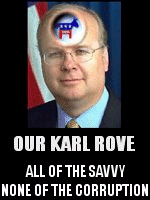
Barack,
Great job with the convention acceptance speech. It was crisp, precise, and direct. But, amongst all the words, imagery, and brilliant concepts, what stands out as your most effective rhetorical weapon is when you get indignant.
It's when you become indignant that the American people finally get to see what really matters to you. You pride yourself on being cool, calm, collected -- a steady mind and a steady hand. No doubt, these are optimal traits of a commander-in-chief and a president presiding over historically challenging times. We need sober decisions by good decision makers who are not unduly influenced by the tactical forces of emotion.
Yet, by the same token, Americans tend to like these traits more in our legislative and judicial bodies than in our presidents. There is a long history of Americans expecting the executive to be passionate, values-driven and leading through a fierce intensity of purpose. You have all of these things, but you keep them behind a bullet-proof emotional vest too much of the time. This is partially why people claim "not to know what Obama is really about" or worry that "Obama is a Trojan Horse." Americans really need to believe they see the man within. Everyone knows where your mind is, but when you get indignant, you give us a sneak peek of where your heart is.
I am simply trying to pull the golden needle out of an astounding oratorical haystack: Letting us "into Obama" to show us where your passions lie is just as important as getting us inspired around your vision for a better future.
Friday, August 29, 2008
Our Nation Digs Obama's Indignation


Saturday, August 23, 2008
Biding Time for Biden: It Was Worth the Wait
Joe,
Congratulations on joining the Obama 08 campaign.
Your proven, intelligence-driven passion to get to the bottom of America's most important challenges is a welcome addition to the Obama campaign.
You perfectly complement Barack -- the combining of his deep intellectual curiosity with your deep and substantive problem-solving skills is a slam dunk ticket for 08.
The McCain camp is going to try to paint this as "admitting" that Obama is lacking skills in foreign policy and governing. And, of course, they'll try to use your own words about Obama during the primaries to muddy up the waters. My strong recommendation is to utilize jujitsu politics -- graciously receive the incoming political fodder, and turn it around on them. I argue that your addition to the ticket means that the very concerns they're voicing are now nullified. Thanks to you joining the ticket, Barack will have the most senior foreign policy adviser at his side every day of his administration -- an adviser who will not only provide him with deep knowledge of foreign affairs, but who will also serve as his "chief navigator and bridge builder" on Capitol Hill.
Joe, you will restore integrity and honor to the position of vice president, and I believe you will work your tail off to undo the awful things that the sitting Vice President has done to this country for the past 8 years.
Congratulations to both you and Barack on forming a most formidable ticket.
Friday, July 18, 2008
Obama's Energy Plan Lacking Energy
Barack,
I fear that you are really missing a key opportunity to not just catapult your candidacy into a double-digit lead, but to show America that Democrats embody the brand of economic, ecological and foreign-policy leadership.
Is there really reason for fear? Well, I recently saw your campaign ad, "New Energy," and what I see in this ad is essentially what I hear on the campaign stump: a series of initiatives that you know will help America move into a new era. Unfortunately, only smart, engaged people like you and your staffers -- those who can intuitively connect the dots -- can get excited about how these initiatives will intermingle to allow America to rise above our current challenges.
The first half of this ad simply explains why McCain stinks (fair enough, though not the "new kind of politics" you kinda-sorta promised us). The second half then outlines a few initiatives and vague promises. In fact, it looks like an ad that could have been run by the Kerry or Gore campaigns (ouch). This ad risks leaving many independent voters thinking "sounds like more-of-the-same Democratic government programs."
Barack, there's a big gap here -- aren't you supposed to be the young, smart, energetic and innovative candidate who's going to solve America's toughest problems? Traditional Democratic frames of programs and policies might do the trick in today's anti-Republican environment, but they'll barely work, and your use of these frames won't advance the Democratic Party brand like many of us thought you might advance the brand.
In fact, you have a responsibility to live up to being the transformative leader you've promised us you are. And that means being a political leader -- that is, a leader of ideas, not just a smart administrator of programs.
Mainstream Americans don't want any more government programs -- they want solutions to their problems.
And here's the irony -- a solution to a problem might very well be a series of programs! But Democrats inextricably reverse the messaging orientation: they tend to extrovert the underlying policies and programs, and introvert the values and philosophies that power them. I call this Democratitis.
But, you, Barack, didn't seem to have this problem in your primary fight with Hillary. She was the one rolling out the litany of programs, and you stood above and bequeathed philosophy. So it befuddles me why, now, you seem to have come down with Democratitis.
Build Your Pillars
Like any structure designed to withstand stress and weather storms, strong campaigns require strategically placed and sturdy pillars. The Obama campaign already has a solid bedrock -- change -- from which to build. Yet, there has been precious little development on this bedrock.
This takes us back to your energy plan as a case in point: Your energy plan is simply sitting on the foundation, with minimal context, no related initiatives, and most importantly, no linkage to your broader strategy. Your energy plan needs a home -- a pillar -- where it is connected to a larger message; where it has neighboring plans that, together, create a community of plans that make up the pillar's raison d'être.
Ultimately, the Obama campaign should define 3-4 pillars that completely encompass your brand, your priorities, and your values. These pillars should be labeled aspirationally, and should act as sub-brands that people can use as linguistic shortcuts to easily and readily discuss the ideas.
To help make the point, which conversation can you imagine happening at the water cooler or over the dinner table?
"So, what do you think of Obama's energy plan, where he is going to make energy independence an urgent priority, raise mileage standards, fast-track technology for alternative fuels, and give us a $1000 tax rebate?"
or...
"So, what do you think of Obama's energy plan, you know, that 'Free, Clean and Green Country' thing where we become free from foreign oil while also cleaning up the pollution by investing in green technologies to help make America beautiful again?"
See the difference? People are much more likely to discuss and share your plans when they're wrapped in a compelling brand than if they are just a list of policies.
The immediate next steps required are:
- Collect all of your initiatives, policies and priorities
- Segment these into 3 or 4 broad categories
- Step back and decide what philosophy or American value powers each category
- Label the category from the solution perspective, and develop slogans based on the philosophy and values powering that solution
When you've built and communicated your campaign pillars, you will then be able to refer to them without having to discuss policies and programs. You will be framing your campaign in a solutions context from an emotional perspective. This is exactly what the voters want and need to hear.
Friday, May 09, 2008
Primal Anger Management (a.k.a. "The Democratic Diamond of Unity")
Hello.
Yes, it's been a while -- two months, in fact. OKR has always been about providing insights when there's something of value to share in terms of advice, strategy and framing for Democrats. With the on-going Obama/Clinton slug fest, there was really nothing I could add that would help or otherwise matter. Unlike traditional blogs, OKR posts occur only when there's a good reason.
I am not in the prediction game, and I've already committed to not backing a candidate in the primaries. After all, as Our Karl Rove, my job is to ensure the Democratic Party is as strong, relevant and productive as possible. Yet as of Tuesday, May 6, a path appears to be clearing for the nomination of Barack Obama.
Both candidates have been amazing in their own, respective ways. Democrats have had a great opportunity to see two different approaches to politics under a banner of virtually identical policies. As we now know all too well, and with a tip of the hat to our friends in the Bush administration, approach matters.
Democrats - please read this carefully: What we've experienced to-date is a competition designed to divide, so it should be of no surprise that Democrats have, in fact, become divided. If Democrats were not divided, then I could argue that the primary process really didn't work. The good news: it worked. The two remaining contenders have learned how to fight each other in preparation for the fascinating fight awaiting Democrats in the fall.
A Diamond in the Rough We're at the final stages of what I call the "bottom half of the diamond." Consider the basic, two-dimensional diamond shape. At the bottom tip of the diamond, the two lines are together, and they gradually separate towards the middle. At the middle -- the very widest part of the diamond -- the two lines are as far apart as they ever will be. This is where the Democratic party is now. But to complete the diamond, the lines must converge once again as they approach the top of the diamond. Once the party re-converges, the diamond will be complete.
But because we're currently in the middle of the diamond, Democrats are naturally at odds with one another: I know people who have come to hate Hillary, and people who think Obama is all talk. These are the artifacts of a manufactured fight. It is now time to start clearing the air...
I Hate Hillary
If you think Hillary is a pandering, trash-talking, lying, neo-con manipulator, this section is for you.
What you need to understand is that Hillary has spent her life in politics and sees it more as a career than a civic calling. No doubt, I think she started in politics for noble and civic reasons. But throughout her career, she was pummeled into cynicism.
Hillary is a professional politician, which means that she sees the political arena like a boxing ring. Just like a boxer, when she gets into the ring, she dons her boxing gloves, inserts her mouth guard, and tries to take the opponent down with all of her might. And, just like a boxer, when she leaves the ring, the match is over. There are absolutely no hard feelings. She is a professional. There's also the idea that her approach to politics reflects the culture of 10 years ago, and the divide-and-conquer approach to winning is showing its age.
So, whenever you felt that she was being a lying, trash-talking, pandering manipulator, just remember that those were just the punches that she felt were her job to throw while in the ring.
Barack Obama is an Empty Shell
If you think that Obama is a smooth talker who has a shady past, and is hiding more than he's showing, this section is for you.
What you need to understand about Barack Obama is that he is not an ideologue. He is not a traditional liberal politician whose sole goal is to push through progressive policies. No; Obama is about process. Obama is less the owner of the idea than the "architect" of how the process of politics should work so that the optimal policies are crafted and backed by broad majorities. He believes this is the only way to truly unite a nation that has been governed by 51/49% splits.
In fact, Obama believes his new political architecture will fundamentally change the quality and results of government. He is not going to fight for universal health care; he's going to create an environment where citizens and their representatives will collaborate to work out a viable solution for universal health care. It's bottom-up policy, not top-down. This approach reflects the future of American culture, although I admit Obama is probably introducing it a bit before it's time -- it'll probably be 10 more years before it truly goes mainstream. But at least this puts Obama ahead of the curve instead of behind the 8-ball.
For those who are used to politicians and politics of the past 50 years, this approach will appear foreign, and can be easily mistaken for seeming downright vacuous. But, to Obama, his platform transcends policy ideology, which he believes is infinitely more powerful and meaningful. Obama is not simply looking to steer the country in the right direction -- he is looking to reconfigure and optimize American democracy for a new era defined by globalization, information, and the resulting interrelations. Heady stuff, no doubt. But the framers of the Constitution were pretty heady in their time, too.
The Low Down
Democrats have been intentionally split into two camps through a process designed to divide. It's critical to understand that it's not Obama or Hillary that created this situation -- it's the very nature of a good primary process.
The key take-away is to acknowledge that if you strongly support either candidate, you're experiencing planned animosity towards the opponent. The sooner Democrats step back and understand that this is planned and not personal (and "see the diamond"), the sooner the Democrats can coalesce around the presumptive Democratic nominee.
To help complete the diamond, send this post to your favorite passionate Democrat so that they, too, can see that they are supposed to be angry with the opponent, and gain a wider perspective that this was all manufactured for the good of the party.
Wednesday, March 05, 2008
John McCain: Lucky, or Set Up for Failure?
Democrats,
In a recent Time article, it is suggested that John McCain may be the luckiest guy on earth. I think Time might be right based on the 2008 presidential campaign thus far. But John McCain is going to need a bit more than luck if he plans on becoming President of the United States.
Surely, the Republican Party would really like for McCain to win the Presidency, but that's not really what they're expecting. They expect to lose. This is why John McCain is in the race in the first place, is why he almost went completely broke in 2007, and is why the money has not been pouring in since Romney left the race weeks ago.
You see, John McCain is their nominee in 2008 for the same reasons Kerry was the Democratic nominee in 2004 -- it's a throwaway election for the Republicans. Now, before you react to this, understand that this should be taken in context. It's not like the Democrats didn't try really hard to get Kerry to win in 2004. But the very premise and quality of the Democratic candidates in 2004 spoke of a Hail Mary pass to the nation: "Here's the pick-up team... let's see if we can't pull an upset!"
Now compare the Democrats' 2004 slate with the Republican 2008 slate. There is a similar dynamic at play. Look carefully at the Republican contestants: A pro-choice Mormon, a southern minister-cum-governor who says the darnedest things, a liberal Mayor, a sleepy actor, and a great grandfather who apologized to Krusty the Clown of The Simpsons when he called Rush Limbaugh a clown.
This is clearly the B-team, and assuredly so since all the internal polls told the RNC back in 2006 that there was no point of injuring the A-team in the current political environment.
None of this means that McCain is guaranteed to lose, of course. Kerry did almost win in 2004. But it does give Democrats a leg up in almost all aspects of this race:
- The grand conservative coalition will not be united, even though they will claim they are
- The good money will not come in unless McCain unexpectedly shows an ability to lead the party
- McCain will spend a lot of energy navigating political land mines the entire race as he bobs and weaves between the competing demands of his electoral and political bases
- The zeal that has powered the conservative movement since 1975 will be diminished
Yes, I know it's tiresome that the Democratic candidates are set to continue battling it out across the nation. But, on balance, this is a good thing. Sure, there will be negative attacks, dress-downs, and money spent fighting amongst themselves. But, more importantly, these candidates will be practicing for the final fight, getting fit and prepped for the big event. In addition, each state that gets a real Democratic primary race will be more invested in that candidate overall. The brand impact and interaction of the two Democratic candidates will be deployed to most every important state in the general election.
The media will continue to get hung up on the mudslinging and the apparent waste of energy in the Democratic primary. But I see it as a great promotional opportunity for the candidates, and the party: the candidates' names, positions and platforms will continue to get tremendous news coverage, and the party will be seen as a dynamic, relevant, and democratically engaged organization.
Compare this to McCain, who, outside of New Hampshire and South Carolina, faintly campaigned for the nomination. And the Republican Party, by comparison, looks more like a coronation party that doesn't care all that much about what American voters really want.
In America, a country that has made it its business to further spread democracy around the world, it would seem like the political party energetically engaged in democracy would be seen as the preferable party at a deep-seated, cultural level.
The Democratic Party continues to demonstrate that it is the party of true American Values.
Monday, February 25, 2008
Lunar Eclipse Sheds Light on Karl Rove
I can't say for sure if my being within spitting distance of Karl Rove was the cause or the result of the full lunar eclipse last week, but the two events did converge at the same time.
This past Wednesday, February 20, we experienced a full lunar eclipse and I attended a Q&A "keynote" session with Karl Rove. It was not an intimate affair, so I was not able to introduce him to his quasi-dopplegänger, but I was able to listen to him speak in long-form about his beliefs, feelings, and approaches to the issues of the day and of the Bush Era.
I paid close attention to what he said, and how he said it in an effort to dig deeper into the mind of my antithesis. What I was able to re-confirm was that Karl Rove is every bit as bright, driven, and savvy as I had expected him to be. What I learned was that he is also quite ideological and protective, while still being a very effective communicator.
I have posted my brief review and analysis of Karl Rove on the Election Integrity blog (interestingly enough, Karl expressed a deep concern for election integrity).
Please post any of your thoughts and comments in the comments area here on OKR.
Tuesday, February 19, 2008
Why You is Better than Me
Democrats,
No, I'm not going jive on you. You is better than me. When running for office (or, in fact, leading any organization), people utilize different levels of leadership in an effort to more effectively connect with their target audiences. During campaigns, voters have the ability to sense the level of leadership a candidate has mastered. And this matters, big time.
What do levels of leadership have to do with you being better than me? A lot -- and they're already having an effect on the 2008 primaries and presidential race. But before we jump right into the current races, it's important to see how leadership levels, and you and me, have played a critical role in prior elections...
A Look Back
The 2000 Election (Bush v. Gore) key messages:
- George W. Bush ran on a lot of ideas (compassionate conservatism, lower taxes, unity [ha!]), but his campaign could be summed up as "I'm the guy who's more or less just like you, so of course I'll represent you the best in the White House."
- Al Gore ran on a lot of ideas as well, which can be summed up as "I'm more responsible than Clinton, and I'm just plain smarter than Bush."
The big idea here is that one candidate had the confidence and wherewithal to always remember who he was courting, and was able to keep his head above water. People see this as a signal of superior confidence and leadership skills. And in national politics, these feelings can trump specific policy platforms (read this sentence a few more times, Democrats).
Now, onto the 2004 Election (Bush v. Kerry) key messages:
- George W. Bush ran on "I'll keep you safe."
- Kerry ran on "I'm ready for duty, and I'm just plain smarter than Bush."
Onto the Democratic Primaries
So, how do the Democratic candidates measure up to the you is better than me leadership approach?
Hillary Clinton (primarily) focuses on the predictable Democratic message of "me"...
- I'll be ready on day one
- I am more experienced
- I am a woman
- I'm going to worry about you every day
- I'm going to fight for you
- I care about you and your troubles
Barack Obama (primarily) focuses on a less conventional message of "we"...
- Together, we can change America
- We are the ones we've been waiting for
- I did not vote for the war
- I will bring people together
- I will change the tone in Washington
So, where do they stand? The answer lies in a simple leadership level calculus: You > We > Me. Simply put, you-first messages are stronger than we-first messages, are both are stronger than me-first messages.
If Hillary plans on winning, she's going to need to shift her focus from the less powerful me-first messages to her more meaningful you-first messages (she'll also need to clean them up to be less pessimistic). She can do this, but it's not very likely due to her depressingly piggish chief strategist Mark Penn.
If Hillary somehow does manage to shift to you, then Obama's movement-like 'we-first' messages get trumped -- he'll have nowhere to go but back to his store of weaker me-first messages. See the problem for Obama? He doesn't have any substantive you-first messages (did you catch that, Mr. Axelrod?). Fascinating.
The General Election
No matter who wins the primaries, Democrats will have a leg up on John McCain. Because, you guessed it, McCain is a me-first candidate:
- I am a war hero
- I am a maverick (ooh, sorry, I mean 'conservative,' my friends)
- I was for the surge when nobody else was
- I called for Rumsfeld's resignation when nobody else did
- I co-wrote McCain-Feingold (notice whose name is first, my friends? Yeah, thought you did.)
To John's credit, he does try to use some we messages as well, but these are secondary and not very popular with his base. Sadly, we as a pronoun rings very socialistic to Republicans.
Barring extraordinary factors, we can use the You > We > Me leadership level calculus to predict who has the best chance of winning races...
The Primary Calculus
Barack's we beats Hillary's me unless Hillary can quickly shift her message to one that says you matter more than she does.
The Election Calculus
Barack's we beats McCain's me. Even if McCain reaches into his backup store of we messages, it'll be hard to compete with Obama's primary we messages.
Clinton's me ties McCain's me, but Clinton has a backup supply of you messages she can deploy for the knock-out punch against McCain's backup selection of we messages.
In the end, while this is all instrumental to success, there is a very simple lesson for any candidate to glean: Voters are the ones voting. Think of them first, and the right words will follow.
Sunday, February 03, 2008
Republican Debate Showcases Republican Abate
Democrats,
By now, you've read all the conventional analysis surrounding the debates leading up to Super Duper Tuesday. But as you also know, this primary season has been anything but conventional.
To make sense of an unconventional political season, best to be armed with unconventional wisdom:
The Republican debate was a great exercise in opposition research. We learned a few important things about the presumptive front-runner John McCain that can be taken to the bank in the general election...
- John McCain is tragically out of step with the fundamental priorities of most Americans. He sees the struggle against radical Islamic extremism as the "transcendent issue of our time: a fundamental struggle between good and evil." McCain asserts that "everything we stand for and believe in is at stake here."
Wow - how quickly old timers can get out of step with reality. It feels like 1991 all over again, replacing George H.W. Bush with John McCain. Seriously, John, is the U.S. vs. Al Qa'ida really the equivalent of good vs. evil in biblical proportions? Or could it possibly be that America is seen as a neo-empire that is trying to control the flow of oil by keeping bases on Arab soil, and manipulating the power equation in the region as we see fit to protect our interests, and not the interests of the Arab people? I'm not saying there's anything wrong with protecting American interests, but what I am saying is that protecting our interests doesn't make them evil (or us good), and it doesn't make the problem transcendent. Rather, the issue is fairly geo-political, and only relevant for as long as we don't have alternative energy sources to rely upon.
In the end, John McCain drank the Neo-Con Kool-Aid and is now apparently drunk on the power and force of Islamic extremism (or, the power of the military industrial complex). It's a shame to hear an American leader of such prominence giving so much credibility to such a marginal faction. Yes, Al Qa'ida has been quite destructive, but more damage from 9/11 has come as a result of America's fear of Al Qa'ida than Al Qa'ida's actual attacks.
If we are determined to throw all of our money, military resources, and energy at trying to find a couple thousand extremists around the world, then we risk looking and sounding like the crazy uncle who tears up his own house looking for his dentures.
By putting this stake in the ground, John is implicitly handing over the economy, global warming, and healthcare over to the Democrats to be their transcendent issues. That's a lot of political stickiness to give your opponent! The only way John wins at this game is if America is attacked again this year. Quite a bet to wage. - John McCain displayed a few instances of old-guy-reaching-for-words-he-couldn't-easily-find syndrome. Look, it's not nice to use ageism as a political tool, but if you don't want political straight talk, then don't come visit Our Karl Rove.
- McCain dismayingly tried to use Bush-like debating strategies as he tried to corner Romney in his supposed support for timetables. He failed miserably. After McCain's campaign tanked over the summer of 07 due to his adoption of a "Bush III" campaign strategy, I thought John learned that he simply can't pull off the assoholic Bush campaign style. Apparently, John hasn't fully shed his Bush advisers. He should. The shoe just doesn't fit.
- Romney is Their John Kerry. Need I say more?
OK, a couple more... - Romney is a center-less super-pleaser who may be smart and a great guy, but is simply not a good national politician. He's not politically savvy, he doesn't communicate well in the symbolic realm, and he is politically uncomfortable in his own suit.
- Romney plays a true conservative on TV, but is too much of a smarty-pants to be a virulent southern-fried conservative that tends to win Republican elections. He's like George H.W. Bush meets Steve Forbes with some hair on top. Blech.
Saturday, January 26, 2008
Bush/Cheney the Reason for an Obama Blow-out in South Carolina?
What we've just witnessed in South Carolina looks like the New Hampshire effect all over again. But that's not even the big news. The big news is that the voters seem to have transformed in ways that are surprising to the Clinton camp.
The results are still rolling in as I'm writing this, but it looks like a wash-out for Hillary and Bill Clinton's candidacy.
Yes, I know I just outraged many people with the above statement. A Hillary and Bill candidacy? A Republican talking point! How dare I. But, you know what? That was Bill's doing. I am no Obama apologist, nor am I a Clinton hater. But the behaviors of the Clintons this week reeked of ugly desperation -- almost equivalent to what G.W. Bush did to McCain in 2000. Bill Clinton's behavior and style started allowing me to see him the way Republicans saw him in the 1990's.
And this is an important point to consider. Why am I drawn to Republican talking points to describe the Clintons? Because the Clintons create an environment ripe for such adversarial knife sharpening. And this from a guy who voted for Clinton twice. Even establishment Democrats began to be appalled by the Clintons' soft-peddling of R&R issues (Race and Reagan) in the past weeks.
The Clintons might be shocked to learn that these tactics don't seem to be working quite as well as they used to. Triangulation, R&R-baiting, destroy the opponent -- all tactics developed and honed by a frustrated "Clinton Democratic" party that witnessed the Reagan revolution and then the follow-up, Gingrich's Contract With America.
The media and many Americans are used to -- and generally expect -- this business-as-usual approach to politics. Most everyone in charge these days lived through the same events, and honed similar tools.
Yet Obama has changed the setting. Tools and tricks that used to fit and match the political decor now seem to fall flat. Strategies that used to be able to manipulate public opinion now seem to backfire.
Is it possible that the Bush/Cheney mis-administration itself is the X factor? Are we all now so keyed into being mass manipulated by this administration that we've developed a political 6th sense since the 1990s? Did Bush/Cheney actually help develop mad skills across the younger band of the electorate?
Perhaps.
Perhaps the zero-sum game is still alive and well -- where the Misadventures of Little Bush have sharpened the electorate that was previously dulled by decades of administrations that did not routinely mislead Americans out of deliberate habit.
Hillary and Bill Clinton will either remain in their echo chamber of the 90s and plow through the only way they and Mark Penn know how to... or they will pivot and recognize that it's a new world -- a world not defined by Barack Obama, but appropriated and symbolized by him.
Tuesday, January 08, 2008
Democrats: Follow Your Inner Winner
Democrats running for office,
As most regular readers of this column know, OKR is not an election horse-race blog. So, don't expect a full analysis of the election escapades here. There are plenty of blogs who are more than happy to play-by-play the fun and sport of it all.
However, as a result of the current horse race, there are some key observations that I've made that I believe are worth calling out and sharing for the good of all the candidates:
Obama's Inner Winner
When Obama (narrowly) lost the New Hampshire primary, he approached the defeat like a winner -- he didn't acknowledge defeat. Instead, he acknowledged the success of his campaign, his message, and his candidacy. He did not -- and has not -- let the media's "shock and awe" of the NH results affect his campaign complexion. He didn't even acknowledge defeat in NH, which some might feel is arrogant. But is it arrogant to decide to believe you didn't lose, but rather believe that you virtually tied?
No, it's not. It's not wrong to ignore the pundits, polls, and conventional wisdom. Doing so (prudently) reflects American-style optimism. While it's clear that this AmeriOptimism is not one of the Democrats' favorite cultural attributes, it's a attitude that -- if embraced properly -- could help win elections.
Message-wise, Barack does need to take a cue from the NH loss and attenuate his rhetoric. Speech upon speech about "changing the world" is great stuff, O, but you're going to have to come down to earth once in a while to re-prove to the voters that you've got some meat on them philosophical bones. The voters need to be armed with information that you communicate verbally (i.e., not just your website) so that Hillary's attacks do not seem as jarring.
Yes, I know that details can ruin a coalition and a movement. Yes, I agree with the approach of staying above the fray, and that running on an idea is the preferable way to run a national campaign. But you're still trying to court Democrats. And, bless their souls, Democrats really do like getting caught up in the facts and details. You are going to have to give them something.
Clinton's Inner Voice
When Hillary (narrowly) won the New Hampshire primary, she told the nation that she "found her voice." Well, that's a good thing to find -- especially after being in politics for "over 35 years." Congratulations are in order, but... how long have you been looking, Hillary?
No matter -- finding one's voice is like establishing one's brand. It creates a center of gravity -- an organizing principle -- from which to grow all messages, platforms, and policies. If Hillary truly has found her voice and doesn't outsource it to her thuggy campaign advisers, she stands a chance of not only beating Obama, but representing a candidacy of meaning instead of a candidacy of policies.
Message-wise, the Hillary campaign just hired sloganeer Roy Spence, which should put the campaign message in capable hands. Hillary just has to try to keep her center close to her. In other words, Hillary, don't lose your voice to the experts around you.
Edwards' Inner Principles
John has displayed an impressive commitment to changing the dynamics of power in America. It seems quite fruitless to most of us, as the existing power structure is set up to give most of us just enough to keep us content with the corrupt and unfair status quo. Yet, John sees a trajectory of power dissemination that troubles him dearly, and is willing to go the mat to rein in unbridled capitalism.
These inner principles are actually quite forward-thinking. What John is touching on will inevitably effect more of us in the coming months and years. I just do not think that we are at the right time and place in American history to make this the central issue of a campaign.
No matter the cultural relevancy, John has shown a visceral passion for systemic change that is attractive to a lot of people (even some Republicans). If he could only broaden his focus to issues facing more Americans right now, his inner principles would be taking him much further.
In the end, Democrats are the winners.
All of this inner stuff is good for the party. The prior several political seasons have portrayed Democrats as outwardly directed -- where campaign messages and political theater have been driven by polls, punditry, and external forces (think Gore in earth tones, Dukakis in tank, Kerry in a swift boat) . Consequently, the American people tend to think of Democrats as "unprincipled" when compared to the "Polls? We don't change our views based on no polls!" Republicans.
The lesson? Focusing on the inner increases your chances of being a winner.
 Add OKR to your RSS reader