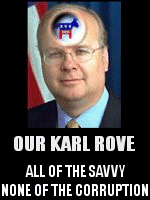
"Our Karl Rove is the blog you should be glad that Democratic strategists don't seem to listen to"
-- what they're saying on Republican blogs

Tuesday, August 29, 2006

"Cut and Run" - Stop Running from It and Start Cutting Through It

Democrats,

Their Karl Rove is staking his reputation on entrapping Democrats using "cut and run" rhetoric. Despite the fact that way too many Democrats have given him the ability to pounce like this, it still sounds to me that Their Karl Rove is turning out to be a one-trick pony who just goes back to what used to work, despite the evolving political environment (a telltale sign of a Conservative Mind). This is good news for you.

While Rove's original trick was really effective, it won't match your new set of strategies. Yes, Democrats, you need political strategies, too. No, not policy alternatives... political strategies. I know it's revolting to the Liberal Mind to think of debasing the concept of public service by polluting your message with turns of phrases designed to manipulate. But, campaigns are not public service -- campaigns are public relations drives. So, worry about doing the right thing after you get elected, OK?

In the past months, it's clear that you've avoided the Wrath of Rove by having nuanced, complex, and varied solutions to the problem in Iraq... all just to avoid the "cut and run" label. This is weak, and the polls support this assessment. Oh sure -- ducking the issue might just work if everything continues to get worse, but what if things moderate or even get slightly better in the next 10 weeks? What then?

For the midterms this fall, follow this recipe to help ensure that your current leads are sustainable, even if things stop getting worse....

Your New Set of Strategies


Strategy #1:
Deflect the "cut and run" rhetoric by proposing a philosophy -- not a policy -- that resonates with Democratic values as well as voters' sensibilities toward the war. This is the antidote to "cut and run." Deploy it at will, wherever possible. If pressed for details, see Strategy #2 below.


"I [Democrats] believe it's time for a change of course for the War in Iraq: It's time to propose and plan for a phase out of American occupation and phase in a support and rebuild effort. While it is our responsibility to help Iraq as much as we can, our 3-year occupation is hurting Iraq and hurting us - it's hurting everybody. When we're done phasing out our occupation, a new American initiative will be part of a coalition of countries who have an interest in supporting and rebuilding Iraq."
Notes about Strategy #1: This strategy calls the war what it is: an occupation. Americans hate that term, and so we need to stick it in everyone's face, and link it with the Republican policy. This messaging also carefully balances our responsibility to Iraq with our need to end the occupation. Support & Rebuild is a positive phrase to be associated with. While it might be implausible to implement, it's a great philosophy to campaign on. And, if nothing else, Democrats need a philosophy to run on.

-------

Strategy #2:
Do not get sucked into solving the problem in Iraq. You can't solve the problem, because you don't have access to the information you need to make a solid policy proposal. Only the Republican Party has full access to this information. And only the American people can give you the keys to access this critical information by voting you into the majority in Congress this fall. Only then can you come up with an alternative plan. Let your constituents know that if you gain majority status, you will instantly be chairing all of the committees, and finally restoring the balance of powers in Washington that should have been serving us all along.


"If Americans vote Democrats back into the majority this fall, Democrats will have the power to stop the spin and spend policy of Republicans and will institute a change of course."
-------

Strategy #3:
Make Republicans look like the hyper-empathetic, bleeding-heart liberals on the War in Iraq that they are. Seriously, Democrats, you've completely missed this dynamic... on the War in Iraq, Bush and the Pubs sound like flaming liberals... caring all about the freedom and happiness of Iraqis more than anything budgetary or fiscal, and just presuming there is universal belief in the implicit value of this agenda. As a result, Bush and the Pubs are putting Iraq's needs above America's in terms of investment, cost, lives, and going after Al Q'aida.


"Democrats believe in completing the War in Iraq on our terms, not Iraq's terms. Democrats don't believe that Iraqis should be determining for us when we're done. When Democrats gain majority status, we will finally be able to tell President Bush and the Republicans when we're done, and why we're done."

-------

Strategy #4:
Make Republicans look lost and confused on the War in Iraq and the so-called War on Terror. If you're thinking to yourself "how?", then you have already bought into a fallacy that the very people who envisioned and executed on these initiatives have no accountability for the results of said initiatives. It's time to wake up to the fact that it's inexcusable for Bush and the Pubs
to have a shred of credibility left on foreign policy.


"Let me break it down for the voters: You can either take a chance and trust me [Democrats] to provide leadership on how we phase out of Iraq, or you can continue to trust the very people who created this disaster in the first place."
-------

Key Phrases to Recite Throughout All Campaigns:

  • Republican policy of Spin and Spend in Iraq
  • Democrats believe in completing the war in Iraq on America's terms, not Iraq's terms
  • Democrats believe in a change of course in our Iraq strategy
  • Democrats believe we need to plan for a phase out of American occupation
  • Democrats believe in phasing in a Support & Rebuild effort in Iraq
  • Voters have a choice: Trust us for change, or continue to trust the Republicans who got us into this mess, and can't seem to clean it up on their own.

These strategies and messages will help crystallize your philosophy, and formulate an approach to counter and neutralize the "cut and run" attack.

Monday, July 17, 2006

Principles Trump Policy

Progressive Blogosphere,

The debate and discussion over Lamont and Lieberman in Connecticut has become increasingly controversial and concerning -- so much so that watching the televised debate became mandatory research for OKR. From an out-of-state perspective, two things became clear after watching the debate:

  • Lamont appears flimsy and whiney, whereas Lieberman appears to have shed his whiney persona and has gotten a lot better at debating since the 2000 campaign.
  • Lamont is running as an outsider and anti-Bush candidate, whereas Lieberman is running as a seasoned, moderate Senator who happens to have a very unpopular policy with regards to the Iraq War.

Bloggers and concerned Democrats who support Lamont, you are falling into a trap. You are supporting a candidate based on a policy instead of his principles. Lamont appears to be a gimmick candidate who is benefiting from a populist campaign focused on a politically-charged topic. Lieberman might not have a popular position in his continued support for the Iraq War, but the Democratic Party will be stronger when it supports candidates of principle and integrity -- even when they appear wrong-headed on specific issues.

How could Lieberman be principled, you might ask, when he supports such a horrible war policy and such a horrible President? He can be principled because while he continues to support the President in the Iraq War, he still believes -- rightly or wrongly -- that his position is the informed, mature, reasonable approach to seeing things through. If he were not principled, he might be seen careening and vacillating with the popular sentiments of the day, month or year. If he were not principled, he might be easily labeled as, say, a flip-flopper. If the man's a hawk (possibly due to an allegiance to Israel, among other things), then the principled thing for him to do is to be honest about his beliefs on the matter, no matter the popularity.

It's easy to see how Democrats might mistrust a politician who seems to be principled. After all, President Bush's ability to appear principled to the average voter was a significant factor in his ability to be almost elected and then re-almost elected. But, just because Bush turned out to be a politically savvy double-talker who merely appears to be principled doesn't mean that Democrats such as Lieberman -- who also appear principled -- should not to be trusted or supported. Conversely, it is arguable that any Democrat supporting the war today has quite a difficult position to manage politically. To contrast, what difficult political positions is Lamont taking?

Then there's Lamont's recent advert of Lieberman's face morphing into Bush. This solidifies Lamont's brand: he is the official "We Hate Bush" candidate. If being anti-Bush is all Democrats and progressive bloggers are looking for in a candidate, then the Democratic Party is but a hollow shell -- a literal shadow of the Republicans (in fact, Democrats are still recovering from being in this exact losing position when they nominated John Kerry in 2004).

So please take pause, step back, do some research on Lieberman's personal life and voting record, and think about his character. Try to look at how he conducts himself as a person and politician outside of the war issue. Think about it...don't Democrats ask moderate, pro-life Americans to step back from that singular issue -- abortion -- and vote on the broad stance on issues of a candidate? Didn't Democrats deride those "other voters" who voted Bush back into office based on a single issue - the war on terror? Or, in some communities, the single issue of gay marriage?

Think about how much you risk inadvertently becoming them as you yourselves get sucked into single-issue politics, and how this feeds a culture of polarization.

Look deep and critically examine exactly what you're supporting and why you're supporting it. Are you supporting a set of guiding principles that strengthen the Democratic Party and subsequent political influence, or are you supporting a set of populist policies that expire rapidly and leave the party constantly on the prowl for the next "anti-[fill in the blank]" campaign?

In the end, I'm afraid Democrats just don't wear "populism" well in today's climate. Populism is easy, cheap, and effective -- and has been the domain of conservatives in modern times. Today's Democrats are supposed to uphold progressive values, which are inherently more difficult to explain because they involve cognitive reasoning, systems thinking, and less usage of mankind's basic instinctive emotional reactions.

Yet, Lamont is running a populist campaign. If Democrats want to differentiate themselves from the failed, populist conservative policies of the past twelve years, now is not the time to support populist Republican clones.

If you follow this line of reasoning, then you just might see that Lieberman is not the Republican clone... Lamont is.

Sunday, June 25, 2006

The 2006 Democratic Party Organizing Principle

Democrats,

There are a lot of issues currently swirling in the national debate, and the media and Republicans are going to hold the Democratic party (i.e., you) accountable for having stances on every issue -- inconvenient or otherwise. If the Democratic party plans on getting back into power this decade, you're going to have to lead, which means having positions on everything.

However, just having stances on the issues isn't good enough.
[oh, and using the adjective "real" to describe your version of policy is, frankly, not effective]

The entire party desperately needs an organizing principle which expresses itself as a party slogan as well as a framework from which to address every single issue on the table. An organizing principle that is consistently used to frame up positions reinforces itself and reinforces the party brand. A single organizing principle will seep into the public consciousness like "compassionate conservative" did in 1999/2000. An effective, well-utilized organizing principle will give you the flexibility to speak briefly in sound-bite mode as well as in-depth about any issue on the table.

After much thought and discussion, Your Karl Rove has developed the Democratic Organizing Principle for 2006:

Striking the Right Balance

Breaking this down, there are some clear advantages to adopting this principle:

"Striking" evokes the feeling of aggression and action. The Democratic Party brand is sorely lacking in these attributes thanks in part to the machismo and rhetoric of the Bush administration. Because America is at war now, being aggressive and action-oriented are required traits of the Democratic brand. Plus, it doesn't sound forced, as this word is an integral part of said phrase, which most everyone is familiar and comfortable with.

"Right" implies a values-based determination, and more importantly, maps to each person's individual idea of what is "right." Getting the individual's values engaged in the conversation makes them a participant, and participants are always more engaged than just consumers of rhetoric.

"Balance" ties into some fundamental American values that resonate with large swaths of voters. Phrases like "the balance of powers," "checks and balances," and "a balanced budget" are positive phrases that will be freely associated with the Democratic brand when this phrase is deployed.

Taken together, these two words not-so-subtly imply that the Republicans do not represent the right balance. The implication is that Republicans represent a party out of balance, and out of sync with core American values. The power here is that your organizing principle implicitly puts Republicans on the defensive without you needing to explicitly attack and appear partisan.

Built-in Flexibility: Nationally, this principle can reinforce the party brand of prudence, insight, and responsibility. Locally, this principle is flexible enough to be used in each individual district, no matter the local political landscape. For instance, striking the right balance just might vary between Mississippi and, say, New Hampshire. This built-in flexibility provides each politician in the field the ability to tweak the balance to effectively represent their district and/or state. Meanwhile, the aggregate power of every politician saying the same phrase will help reinforce the national brand, which in turn will further support local races. It's called a positive feedback loop, and it's high-time that the Democratic Party benefited from one of these, don't you think?

This organizing principle can be expressed in many different ways to solve many different political challenges. Here are just a few examples of its potential application:

The 2006 party slogan - Democrats, Striking the Right Balance for America

For sound bites on policies: Democrats represent striking the right balance on...

  • individual privacy and collecting intelligence
  • indefinite war and immediate withdrawal
  • tax relief and the national debt
  • immigration and naturalization

For a values debate: Democrats represent striking the right balance on...

  • individual freedom and federal laws
  • religious freedom and federal laws

For a national campaign metaphor:

"Democrats represent ushering the country back to the right balance in Washington. For too long, there has been only one party in power, clearly with no ability to keep itself in check. This has resulted in a single-party imbalance, with the unfortunate consequences of a never-ending war, higher gas prices, loss of individual privacy, corruption, scandals, torture, and Bin Ladin still on the loose. To strike the right balance, which will lead us to the best solutions, we need to have Democrats in power to hold this administration accountable. This means voting Democrats into power in the U.S. Congress in 2006."

With these examples, you can start to see how this organizing principle can be broadly applied to an almost infinite set of political challenges.

Of course, for specific races, these points will fall flat unless the deeper meaning of what "balance" means is communicated -- folks can't just say "I believe in striking the right balance between privacy and collecting intelligence" without having specifics around what this means to them. But, whatever details local politicians decide to explain after the organizing principle is set, these details will naturally be heard in the context of balance. You will be conditioning the voters before you tell your story.

After five years of imbalance by design after 9/11, the pulse of the nation is telling us that we're ready to shift back into an era of balance, competence, and a renewed interest in working toward a stronger whole, instead of a weaker divide.

Monday, June 05, 2006

Same-Sex Stunts

Democrats,

With all of the focus on same-sex marriage, those Republicans must not really be that concerned about what Americans really care about: our brave soldiers fighting and dying in a failed war, Bin Ladin still on the loose, federal corruption scandals, astronomical deficits, a larger and more intrusive government, or an economy that has lost its appetite for the middle class.

Instead, this administration and their rubber-stamp congress would rather further the agenda of intolerance by trying to once again ban gay marriages through a constitutional amendment.

Funny how big-governmental activism is back in vogue under the Republican brand, isn't it? Funny how focusing on intolerance and division is the only way Republicans think they can win elections anymore? Funny how an abysmal administration tries circus-style stunts in an attempt to win votes, isn't it?

Don't miss a beat on this: Democrats will not participate in Same-Sex Stunts when this country has so many other more pressing issues. If Republicans think that ending gay marriage will help us win the war on terror, put an end to deficit spending, improve the economy, and end government corruption, then all the power to them.

Democrats, instead, will continue to focus on the pressing issues that define our time:

  • Ending the Era of Terror
  • Rebuilding the American middle class dream
  • Focusing on American innovation and strength gained from working together
  • Creating "Smart Security" for America through advancing energy independence, border management, and putting an end to the era of global warming

As long as Republican remain a single-party majority throughout Washington, Americans will continue to be victims of political stunts designed to pit us against each other. These stunts waste our tax dollars, get nothing accomplished, and continue to weaken America's defenses against the real threats of our time: Al Q'aida, the middle-class economy, global warming, and the national divide.

Call a spade a spade: The Republican Congress, combined with the out-of-touch Republican administration, are clinging desperately to political stunts in order to try to keep their majority when the real business of moving America forward is being ignored.

Americans are sick and tired of Republicans choosing political stunts over real progress. It's time for a change in leadership in congress.

Thursday, May 25, 2006

Everything's Getting Worse

(It's Time for Things to Start Getting Better)

Democrats,

The national mood is now ready for you to come out swinging without sounding "anti-patriotic" or "one with the terrorists."

To put it bluntly, the Republican leadership over the past six years has made everything worse for America.

  • The economy? Worse, except for CEOs and oil companies.
  • Safety? Worse, with global terror on the rise, and Bin Laden still on the loose.
  • Jobs? Worse, with no "next big thing" on the horizon domestically to create new jobs.
  • Taxes? Worse, with over 100 new tax forms created since Bush and his congress took office in 2000.
  • Tax Relief? Worse, because high gas prices are just as bad as high taxes.
  • Religion? Worse, with the erosion of separation between church and state. Our Founding Fathers never wanted it this way.
  • Values? Worse, with corporate and government corruption on the rise under Republican leadership.
  • Vision? Worse, with the biggest ideas being a mission to Mars and WMD's in Iraq.
  • Deficit? Worse, with the largest federal spending in history after Democrats left them a surplus.


Republicans are going to spin this a thousand ways to Sunday, but it's doesn't much matter how they spin it: the results are in, and the Republican Way of Governing has proven not to work.

You can be honest when talking to your constituents: Democrats still need to work harder on their stance on key issues. But tell them where you stand on your issues.

Tell your constituents to vote for you in 2006 to bring the values of discipline, accountability, competence, and innovation back to Washington. Let's start fixing the things that Bush and the Republicans broke.

Saturday, May 06, 2006

Stamping Out Blank Checks and Rubber Stamps

Democrats,

I don't have to tell you how critical it is that we end the era of single-party governance. Americans need and deserve a balance of power in Washington for the duration of Bush's term. This is why OKR will be focusing on providing messaging and politically effective solutions throughout 2006 to help ensure that Democrats take at least one chamber of congress back this fall.

We all know that there are going to be some tough races, and you cannot assume that Bush's unpopularity will automatically give you an advantage. It is incumbent upon every politician running for office to continually connect the dots between your local race and the mess this administration has gotten us into.

"Normally, this would be a race between me and my opponent -- a race to decide who represents the citizens of our [district/state]. However, this is no ordinary time in America's history. We are living in a time where the Republican party has led our country into a disastrous war, spent us into unprecedented national debt, desecrated our laws, corrupted the values we hold dear, and grew larger and more invasive than any administration in our lifetime.

But I'm not so shocked. Besides the double-speak and the false promises, this is an administration that has its own party in congress, ensuring that they could do whatever they wanted to do, and spend on everything they wanted to spend using your money, with no questions asked. What I'm saying is that the Republican majority in congress has been in the back pocket of this administration.

When you vote for me this fall, you will be voting "no" to scandals, "no" to massive debt, "no" to leaks, "no" to high gas prices, and "not good enough" to the management of the Iraq war. When you vote for me this fall, you will be voting "yes" to pressing forward in new and better ways for our great nation.

Remember, my friends and colleagues, a Republican in congress is a blank check and a rubber stamp for this administration."

Wednesday, May 03, 2006

Rock the Bloat

Democrats,

Spring is the time to start building up the arsenal of themes that you'll use to distinguish your party from the opposing party, and to give yourselves a strategic advantage in the fall elections.

Let's focus on a theme that will cut across ideologies and become a clear winner for you: the bloated federal deficit.

The Republicans have been in charge for six years, spending Americans' tax dollars faster than people can send them in. The big question is: on what? What have they been overspending on that has made Americans happier and healthier? Consider a stump speech along these lines...

"Looks to me like the Republicans are, once again, out of touch. They're spending all of your money on things that you won't benefit from. That's what happens when only one party is in charge. It's like your teenager wanting to buy a Cadillac Escalade because it looks cool, and not having a Mother around to say 'that's nice, but where are you getting the money for that?'

There's just too much bloat in the lobbyist-infested Republican budgeting scheme. Vote Democratic in 2006, and we promise to find out exactly what the Republicans have been spending Americans' tax dollars on. And then, we're going to force a decision: either put our tax dollars to better use, or tell the American people exactly how you plan on wasting their hard-earned dollars."

This is an important inflection point for the party. It's an opportune time to own up to being the party of fiscal discipline, and stripping it out of the Republican brand. It's time to take credit for, and feel proud of, your record of only taxing when necessary to support the basic pillars of our country: healthcare, energy, the economy, and stronger communities. Once these fundamental values are secure, you can tell your constituents it'll be time to look at reducing taxes again.

Speaking proactively about the deficit will help you strip "tax & spend" from your brand, and transform it to "rebuilding the pillars of our country" in accordance with American values (even so-called "Christian voters" won't be adverse to talking about stronger communities and healthcare).

This is part of a pattern you will continue to see here on OKR... redefining classic debates with language and context that changes the dynamic, giving you an advantage on issues that matter. I know that a lot of Democrats see this as "Republican Light," but it's not. Rather, it's about enlightened values through an unconventional lens designed to resonate with the masses... rather than the fringes.

Sunday, April 23, 2006

Here It Is: The Democratic Plan for Iraq

Democrats,

One of the most vexing issues for the party is that you have no single, coherent plan for the Iraq war. Good news: now you do. Please read on...

Our overly-simplistic competitors in the Republican party see the world in black and white: either fight until victory or cut and run. While this is definitely simple to understand, it's also unimaginative, and clearly a losing strategy.

Something you might want to share with your constituents is that Democrats are better at planning, so it's no surprise that you have a better plan:

End the Iraq War Without Cutting and Running

  1. End the Iraq War immediately because the original reasons for war are no longer concerns (no WMDs, Bin Laden isn't there, and global terrorism hasn't been stifled by us being there).
  2. Simultaneously with ending the war, immediately begin a rebuilding coalition with the UN and neighboring nations.

Why is this is a better plan? Because if history started today, and we found Iraq in the situation it's in right now, we all know we would not go to war with Iraq. Instead, if we saw a strategic country like Iraq with such internal instability, we would no doubt engage -- and lead -- the global community in establishing stability and rebuilding the country to make it a functioning nation.

So, should we approach Iraq based on what it is, or based on what we thought it was? It's a no-brainer: We should approach Iraq based on the situation on the ground today, not based on faulty ideas, notions, and decisions that Republicans have made in the past.

The Democratic Party is about the future (which is why you consider yourselves progressives), and the Democratic plan for Iraq calls for looking forward, not looking back. We will win in Iraq if we stop investing in our mistakes and start investing in the future.

With this plan, all Democrats have something simple, positive, and interesting to say when asked by the media what Democrats would do differently than this administration in Iraq. By having a single, coherent plan for Iraq, you can change the conversation about "pro-war vs. anti-war" Democrats into a clear, strong and consistent progressive approach to U.S. foreign policy.

This is the kind of plan the party needs in order to regain foreign policy legitimacy. Americans want choices, and it's your job to give it to them. Stop hedging and start leading by consistently communicating a responsible, progressive alternative to Republican incompetence.

Wednesday, April 05, 2006

Immigration Discrimination

Democrats,

I don't quite know where this immigration issue came from. Sure, it's a national issue, but with all the things going on in the country and in the world, I'm guessing that this is a situation where their Karl Rove is trying to redirect the national anger toward the administration's handling of the war to border-leaping Mexicans.

Don't fall for this tactic.

Immigration is an issue, but so are a lot of things. Not addressing it directly does not make you unpatriotic or irresponsible. Effective governing is about picking your priorities and sticking with them until there is just cause to reassess them.

Worse, when being directly asked if you're for or against illegal immigration and stricter border control, most Democrats I've seen on TV are hesitating and vacillating. This is ugly, because it's very Kerry-esque and plays into the party persona that you live in a liberal echo chamber of hyper-empathy with no ability to be tough on policies that require enforcement.

Reframe the issue of immigration in terms of your priorities -- the issues that you believe are important.

First, sound direct in your response so it sounds like you're answering the question, but instead of answering, you sound like a patriot:
"Of course Democrats are against any illegal immigration. Most people and almost all businesses agree that immigration is critical to our economy, and continues to make America the best country in the world. It just doesn't make sense for something so important to our country to be so outside the law. Democrats are for updated laws to ensure that law-abiding immigrants are legal, and that people who come here just to exploit our country by selling drugs are shipped back to their home countries."

Next, turn this issue into a wedge that isolates the Republican Party on their failings in keeping America secure:

"There are numerous problems like immigration facing America today, and the number of problems is rapidly rising due to incompetent and misguided Republican management of this great nation. Yes, we're worried about Mexican immigration, but we're also worried about the immigration of dirty bombs through our unprotected ports, and we're worried about the immigration of terrorists through our underprotected airports. Democrats have proposed funding protecting our ports over and over again, and we support advanced technology to make flying safer, but this Republican congress has squashed all port reform bills sponsored by Democrats."

Essentially, you want to communicate that if Americans put Democrats in charge of any part of our government, you promise to focus on all of our immigration issues -- immigration issues that not only keep our country a great nation that invites new immigrants who want to live the American Dream, but "national security immigration" issues that will stop another 9/11 attack from happening.

Friday, March 31, 2006

The Indy 2006

Democrats,

According to a recent Gallup Poll, one of the key challenges for this year's congressional elections is going to be maintaining the momentum in the evolving feelings of the independent (Indy) voter.

With the hugely effective rhetoric of the Bush Administration and the entire Republican Party since 9/11, Indies stepped off their perch and landed with Republicans in large numbers, believing that foreign policy toughness was required, and that Republicans were the kind of politicians that were going to kick ass and take names.

Many asses and not nearly enough names later, the Indies (who have less ideological allegiance and therefore are less emotional and more analytical in their voting preferences) see how these so-called tough guys overreached, overspent, and overkilled -- and now Indies want an overhaul.

A core component of your messaging strategy needs to focus on responding to this shift in independent voter thinking. Be the party designed to overhaul the party-in-charge by convincing your constituents that a Democratic majority in congress will provide the required oversight and competence needed to put this country back on the right track.